Expert Faucet Repair in Austin: The Complete Homeowner’s Guide for 2026

Updated: Jul 14
That steady, rhythmic drip in your kitchen sink isn't just a minor annoyance. It's a quiet alarm signaling that Austin's notorious hard water is slowly claiming another fixture. Finding reliable faucet repair Austin homeowners can trust is often the only way to stop the waste before it impacts your monthly budget or your home's infrastructure.
It's incredibly frustrating to watch your water bill climb while white mineral crust destroys the finish on your expensive hardware. You deserve a solution that lasts, rather than a temporary patch that fails in a few months. Most homeowners simply want their water pressure restored and their fixtures protected without the pressure of unnecessary replacements.
This guide provides the clarity you need to handle these repairs with confidence. You'll learn how to diagnose common leaks, troubleshoot internal parts, and shield your plumbing from the damaging effects of Central Texas minerals. We will cover everything from identifying specific brand components to restoring full flow. This ensures you can stop the drip immediately and know exactly when to call a professional who values craftsmanship and integrity over a quick sale.
Table of Contents
Identifying Common Faucet Problems in Austin Homes
Austin water is unique. Our limestone-rich sources deliver high levels of dissolved calcium and magnesium directly to your kitchen and bathroom. These minerals don't just flow through your pipes; they settle and calcify. This creates a sandpaper-like environment inside your valves. When residents seek faucet repair Austin professionals frequently discover that internal components have been ground away by these abrasive mineral deposits. It is a chemical reality that dictates how we maintain our homes.
In historic areas like Hyde Park, the situation is more complex. Older homes often feature original plumbing that has developed narrow internal diameters due to decades of buildup. When you combine this with the shifting clay soil of Central Texas, you get a recipe for structural stress. As the ground expands and contracts during our seasonal weather shifts, it tugs on your home's foundation and plumbing connections. This often results in silent leaks. You might not hear a drip, but a sudden spike in your utility bill suggests water is escaping somewhere behind your walls or beneath your cabinets.
The Mineral Factor: Limestone and Your Aerator
Austin is currently in a "Conservation" water restriction stage. To meet these goals, many homeowners have installed low-flow fixtures. While efficient, these fine-mesh aerators clog much faster than standard models because the smaller openings trap limestone particles easily. To understand the physics of this process, it helps to learn how faucets work and how water is regulated at the point of exit. Mineral scale appears as a white, chalky crust. Unlike standard mechanical wear, this scale is corrosive. It can permanently pit and ruin high-end finishes like matte black or brushed brass if it isn't addressed early.
Pressure Problems in Round Rock and Pflugerville
Municipal water pressure in areas like Round Rock and Pflugerville can fluctuate significantly. While high pressure feels great in a shower, it's brutal on the delicate O-rings inside your kitchen and bathroom faucets. When pressure exceeds 80 PSI, internal seals are pushed beyond their design limits. This leads to sudden, catastrophic failures rather than slow drips. We always recommend checking your pressure reducing valve (PRV) during any repair. Ensuring your PRV is functioning correctly is a proactive way to protect your fixtures from the stress of local water main surges.
Understanding Faucet Mechanics: From Aerators to Cartridges
Every faucet in your home serves the same purpose, but the internal "engines" that control the water vary significantly. When performing a faucet repair Austin homeowners often find that the solution depends entirely on whether they have a compression, ball, disk, or cartridge model. Understanding these differences is the first step toward a successful fix. While a compression faucet relies on traditional rubber washers, modern cartridge and ceramic disk models use more sophisticated engineering to provide a leak-free experience.
In our local environment, we've found that cartridge-style faucets are the superior choice for residential upgrades. Their design simplifies maintenance because the entire internal mechanism is contained within a single, replaceable unit. This is particularly helpful when dealing with the grit and scale common in Central Texas water. If you're considering an upgrade to a more durable model, exploring new faucets and fixtures can save you from frequent repairs down the road.
We always emphasize the use of Original Equipment Manufacturer (OEM) parts during any faucet repair Austin project. It's tempting to grab a generic "universal" repair kit from a big-box store, but these often lack the precision required for a long-term seal. A Master Plumber knows that a fraction of a millimeter can be the difference between a silent sink and a midnight drip. Craftsmanship requires the right materials to ensure your repair lasts for years, not just weeks.
How Each Faucet Type Operates
Compression faucets: These are the oldest type. They use two handles and a screw-like mechanism to compress a rubber washer against a valve seat. They're often found in older Austin homes and require the most frequent maintenance.
Ball faucets: Frequently found in kitchens, these use a single handle to move a slotted metal or plastic ball over a set of springs and rubber seats. They have many moving parts that can fail simultaneously.
Ceramic disk and cartridge faucets: These represent modern proficiency. Ceramic disks are nearly diamond-hard, making them highly resistant to the abrasive minerals found in our local water. They're built for longevity and smooth operation.
While these residential designs are effective for home use, the engineering principles of fluid control are universal; for example, technical resources from industrial valve suppliers UK like OG VALVES LTD. offer deep insights into selection standards and performance for high-stakes industrial applications.
Internal Components That Fail Most Often
The most common culprit in a leaky faucet is a worn O-ring or seal. These small rubber components act as the primary barrier against leaks. Over time, they become brittle or get sliced by mineral deposits. Another critical area is the valve seat, which connects the faucet to the water supply. If the seat becomes pitted or corroded, a simple washer replacement won't stop the leak. Finally, don't overlook the aerator. This small screen at the tip of the spout can become so clogged with scale that it restricts flow or causes water to spray in odd directions.
Faucet Repair vs. Replacement: A Homeowner’s Comparison Guide
Deciding whether to salvage a dripping fixture or start fresh requires a balance of logic and long-term planning. In the context of faucet repair Austin residents often face this choice sooner than expected. Our local mineral content acts as an accelerant for wear. We generally advise homeowners to follow the 50% rule. If the estimated cost of parts and labor for a repair exceeds half the price of a high-quality new fixture, replacement is usually the more responsible investment. It's a matter of protecting your home's value and your future maintenance budget.
Age is the most reliable indicator of a fixture's remaining life. While a premium brass faucet can technically function for 20 years, the high calcium levels in Central Texas often degrade internal valve seats by the 10-year mark. If you notice "pitting"—small, jagged holes in the metal finish—the damage is likely structural. Aesthetic failure is frequently a symptom of deep-seated corrosion that a simple seal replacement cannot fix. Choosing a modern, WaterSense-certified model can also help you meet the city's 2026 water consumption goals, potentially reducing waste by up to 30% compared to older, less efficient designs.
When to Choose Repair
High-end hardware: If you have a relatively new, designer fixture, a targeted repair is almost always the right choice.
Sentimental or historic value: For homes in neighborhoods like Tarrytown, original vintage hardware is often worth the extra labor required for a custom fix.
Minor mechanical issues: When the problem is limited to a clogged aerator or a single worn O-ring, a professional can restore full function quickly without the need for a full teardown.
When Replacement is the Smarter Investment
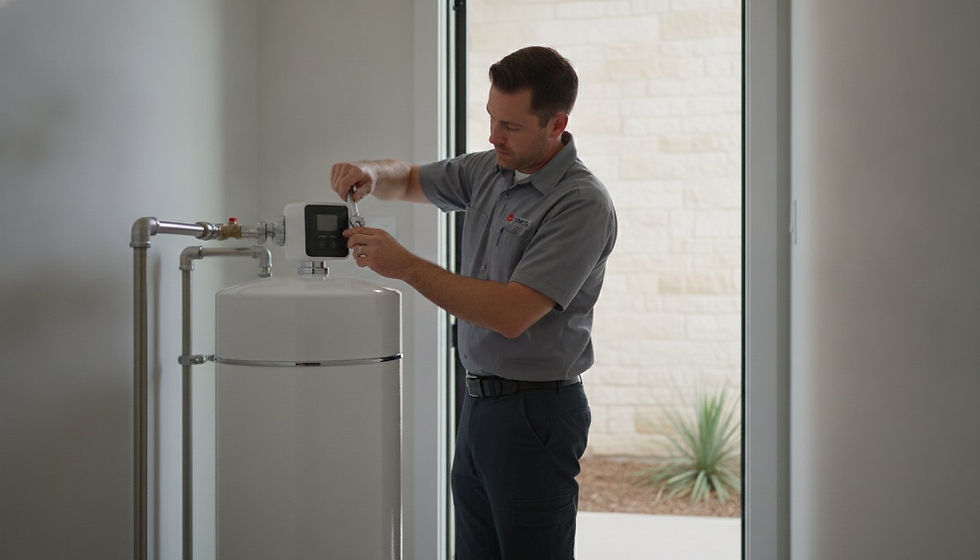
Internal corrosion is the most common deal-breaker. Once the main valve body is compromised by Austin's hard water, even the most skilled Master Plumber cannot guarantee a leak-free seal. Replacement is also necessary for discontinued models where OEM parts have vanished from the market. This transition is the perfect time to consider a professional water softener service to protect your new investment from the same mineral buildup that destroyed the previous one. Starting fresh with modern proficiency ensures your home remains a sanctuary of reliability and craftsmanship.

Practical Maintenance and Troubleshooting for Central Texas Faucets
Maintaining your fixtures is an act of stewardship for your home. Before you begin any inspection, you must know how to safely isolate the fixture. Locate the small "angle stop" shut-off valves typically found inside the cabinet beneath the sink. Turn them clockwise until they are snug. If these valves feel brittle or refuse to budge, don't force them. This is often the first sign that you need professional faucet repair Austin homes require when aging parts finally seize up. Forcing a stuck valve can lead to a sudden pipe failure.
Austin's hard water makes the "vinegar soak" a necessary local ritual. Simply fill a small plastic bag with white distilled vinegar and secure it around the faucet head with a rubber band. Let it sit for two to four hours. This acidic bath dissolves the calcium buildup we discussed earlier without the need for harsh, abrasive chemicals. It's a gentle way to restore your water's flow pattern while preserving the integrity of the metal. Once finished, remove the bag and run hot water to flush out the loosened minerals.
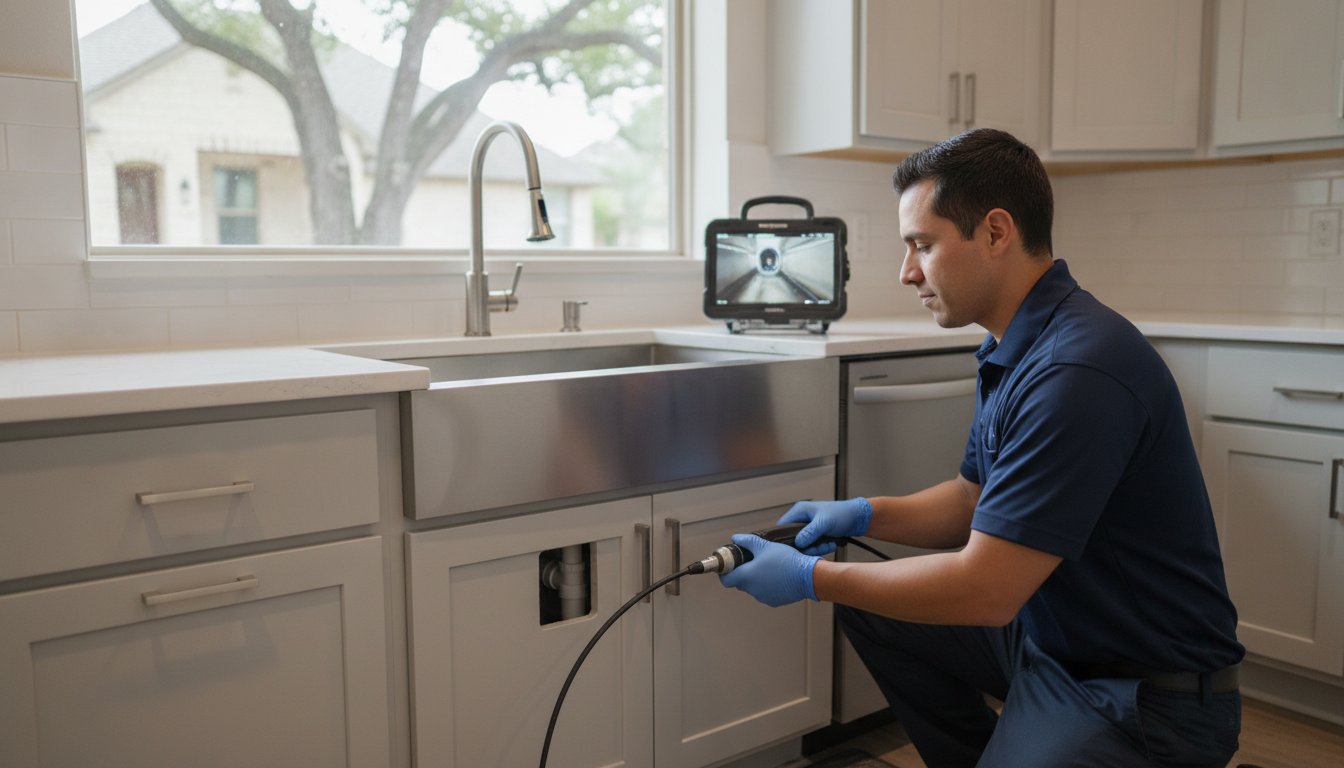
We always recommend keeping a clear space under your sinks. This allows you to spot moisture early. Use a flashlight once a month to check the back corners for dampness or dark spots. Catching a small leak now prevents the growth of mold and protects your cabinetry from expensive structural rot. If you're unsure about the state of your plumbing, it's wise to schedule a professional inspection to ensure everything is operating correctly.
DIY Maintenance Tips for Austin Homeowners
To clean mineral deposits from the faucet body, use a soft microfiber cloth and a 50/50 mix of water and vinegar. Avoid steel wool or scouring pads. If you have a pull-out spray hose, pull it out to its full length and wipe it down. Check the braided casing for small frays or dampness, which indicate a hidden leak is starting to form. Occasionally, what looks like a faucet leak is actually a slow drain causing water to back up. Clear your sink's P-trap regularly to ensure water exits as quickly as it enters.
Preventing Future Fixture Damage
There is a direct link between leak detection services and the longevity of your faucets. Hidden leaks in the supply lines can cause pressure imbalances that stress your faucet's internal seals. We recommend annual plumbing inspections to catch these issues before they escalate. Simple habits also make a difference. Avoid "slamming" the handle shut. A gentle touch preserves the life of the internal cartridge and keeps the valve seat smooth for years of reliable service.
Professional Faucet Services: Why Local Expertise Matters
When DIY efforts reach their limit, you need a partner who understands the specific plumbing DNA of Central Texas. Garrett's Plumbing brings 27 years of experience and four generations of trade expertise to every home. This isn't just a business for us; it's a family legacy built on the foundation of old-school reliability. When you search for faucet repair Austin residents trust, you're looking for someone who treats your sink with the same care they'd give their own grandmother's kitchen.
Hiring a licensed Master Plumber is critical for more than just stopping a leak. It's about protecting your home's infrastructure and maintaining manufacturer warranties. Many modern high-end fixtures require professional installation or repair to keep their long-term coverage valid. Our team ensures every job meets the strict standards of the International Plumbing Code while addressing the unique mineral challenges we've discussed. We serve the entire metro area, providing consistent quality from San Marcos in the south up to Georgetown in the north.
Our approach is rooted in integrity. We prioritize an honest diagnosis before ever suggesting a full replacement. If a cartridge can be cleaned or a seal can be replaced to give you several more years of service, that's the path we'll recommend. We value long-term relationships over a quick sale. This ethical standard is why Austin families have called on us for decades. We combine traditional values with modern proficiency to ensure your plumbing remains silent, efficient, and reliable. This focus on expert diagnostics extends to other critical systems as well; for example, you can visit Legacy Home Comfort to learn more about professional HVAC maintenance and residential system repairs.
The Value of Multi-Generational Knowledge
Four generations of plumbing knowledge allow us to solve mysteries that often baffle less experienced technicians. We've seen how Austin's infrastructure has evolved, from the cast iron pipes of historic neighborhoods to the PEX systems in new developments. This historical depth means we don't just apply a quick patch; we provide a heritage-quality repair. We understand the "right way" to handle delicate hardware, ensuring that the craftsmanship matches the aesthetic of your home. We treat every client like a neighbor because, in Austin, you are one.
Ready to Stop the Drip?
You don't have to tolerate a spike in your water bill or the constant sound of a dripping tap. Whether you need a scheduled fixture consultation or an emergency plumbing Austin repair, our licensed team is ready to help. During a service call, you can expect a methodical, detail-oriented professional who respects your environment and provides clear, transparent communication. Trust the local experts who have kept Austin flowing for decades. Let's restore the comfort and efficiency of your home today.
Protecting the Heart of Your Austin Home
Managing the health of your fixtures in Central Texas requires a mix of proactive maintenance and professional insight. You now have the tools to identify the abrasive effects of hard water and the knowledge to decide between a simple repair or a full replacement. Whether you're soaking an aerator in vinegar or evaluating a corroded valve seat, your goal is to protect the integrity of your home's infrastructure. It's about more than just stopping a drip; it's about preserving the value of your property for years to come.
When a project exceeds a simple fix, choosing a partner with a deep local history ensures the work is done with precision. Our team brings 4 Generations of Texas Trade Expertise and 27+ Years Serving the Austin Metro Area to every task. As Licensed Master Plumbers, we focus on craftsmanship that respects both your environment and your budget. When you need faucet repair Austin professionals can perform with integrity, we are ready to help. Contact Garrett’s Plumbing for Expert Faucet Repair in Austin. We look forward to providing the steady, neighborly service your home requires. You can enjoy a leak-free home and the peace of mind that comes with expert care.
Frequently Asked Questions
How much does faucet repair typically cost in Austin?
The cost for professional assistance depends on the complexity of the fixture and the availability of specific replacement parts. While a simple washer replacement is a straightforward task, repairing a custom or historic fixture often requires more labor and specialized components. We always provide a clear, integrity-first diagnosis of the issue before starting any work to ensure full transparency for the homeowner.
Why is my faucet making a whistling or vibrating noise?
A whistling or vibrating noise usually indicates a loose internal part or a restriction in the water flow. This can be caused by a worn-out washer vibrating against the valve seat or air trapped in the supply lines. If the noise is widespread throughout the house, it may point to high municipal water pressure. In these cases, a Master Plumber should check your pressure reducing valve to protect your fixtures.
Can hard water actually break my faucet beyond repair?
Yes, the high mineral content in our local water can cause irreversible damage to plumbing fixtures. Calcium and magnesium deposits can pit the metal surfaces inside the faucet body. Over time, this creates a rough surface that prevents new seals from seating correctly. Once the structural integrity of the valve body is compromised by this corrosion, a full replacement is the only reliable solution.
How do I know if I need a new faucet or just a new cartridge?
If your fixture is less than ten years old and the metal body shows no signs of pitting, a new cartridge usually solves the problem. However, if the handle is difficult to turn or the finish is peeling due to internal corrosion, the damage is likely too deep for a simple part swap. A professional faucet repair Austin specialist can inspect the valve seat to determine if the unit is still salvageable.
Is it normal for a kitchen faucet to leak from the base of the handle?
Leaking from the base of the handle is a common sign of a failed O-ring or a loose adjusting ring. While it isn't "normal" for a healthy fixture, it's a frequent issue in Austin due to mineral grit slicing through rubber seals. Ignoring this leak can lead to water seeping into your cabinetry. This often causes mold and wood rot that is much more expensive to fix than the faucet itself.
What are the most durable faucet brands for Central Texas water?
We recommend fixtures with solid brass construction and ceramic disk cartridges for the best durability in Central Texas. Brands like Delta, Moen, and Kohler are reliable choices because their replacement parts are widely available. Avoiding plastic internal components is key. Plastic degrades much faster when exposed to the heat and minerals found in our local water supply, leading to premature failure.
Do I need to call a plumber for a slow-running faucet?
You should first try cleaning the aerator with a vinegar soak to see if that restores the flow. If the pressure remains low after cleaning the screen, the problem likely lies within the cartridge or the supply lines. A slow-running faucet can also be a symptom of a failing pressure reducing valve. This requires a professional to diagnose and fix safely to prevent damage to other appliances.
How long should a high-quality bathroom faucet last in an Austin home?
A high-quality bathroom faucet typically lasts between 10 and 15 years in an Austin home. However, this lifespan can be significantly shortened if you don't have a water softener to manage mineral buildup. Regular maintenance helps ensure you get the maximum life out of your investment. Cleaning the aerator and checking for small drips early can prevent the type of catastrophic corrosion that forces a premature replacement.
Comments