Kitchen Faucet Repair in Austin: A Homeowner’s Step-by-Step Guide

Updated: Jul 4
What if that small, rhythmic drip under your sink is actually a symptom of the very ground Austin is built upon? It's a common sight for many of us. You notice a leak, try to tighten the handle, and realize that stubborn mineral deposits have already started to take hold. We understand the frustration of seeing a beautiful fixture marred by scale or watching your utility costs rise because of a constant drip. Dealing with kitchen faucet repair Austin requires more than just a wrench; it requires an understanding of how our local environment treats your pipes.
We believe in doing things the right way, which starts with empowering you to care for your home. This guide will help you master the basics of faucet repair while teaching you how Austin’s unique hard water affects your plumbing longevity. According to recent water quality data, our local water averages about 93 ppm of mineral content, which often leads to scale buildup inside your fixtures. You'll learn a clear, step-by-step process to stop leaks and restore your sink. We'll also cover the maintenance habits that keep your kitchen running smoothly and help you identify exactly when it's time to call a professional to ensure your home stays dry and protected.
Table of Contents
The Austin Hard Water Factor: Why Kitchen Faucets Leak
Austin’s water supply is a product of our local geography, sourced primarily from the mineral-rich Colorado River. While this water is safe and meets all federal standards, its mineral profile presents a unique challenge for homeowners. With an average hardness of 93 ppm according to the 2025 water quality report, our water carries significant amounts of calcium and magnesium. These minerals don't just stay in the water; they eventually solidify into "limestone" scaling inside your fixtures. By 2026 plumbing standards, it's recognized that high mineral concentrations specifically degrade faucet O-rings by leaching plasticizers from the rubber, causing them to become brittle and snap under normal operating pressure.
Kitchen faucets often bear the brunt of these issues because they are the most frequently used fixtures in the house. Every time you fill a pot or rinse a dish, mineral-laden water flows through the internal components. This high volume of use makes kitchen faucet repair Austin a common necessity for those living in Central Texas. Understanding how faucets work is the first step in diagnosing why these leaks occur in our specific environment. When you know the mechanics, you can better appreciate how a tiny amount of mineral buildup can lead to a significant headache.
Identifying Mineral Buildup (Scaling)
You’ll typically notice mineral buildup as white, crusty deposits around the base of the spout or the aerator. This isn't just an aesthetic problem. Scaling creates a rough surface that acts like a metal file against the smooth rubber seals and gaskets inside your faucet. During Austin's frequent drought cycles, lower reservoir levels can lead to higher mineral concentrations in the city water supply, which accelerates this abrasive wear. Every turn of the handle then becomes a moment of friction that slowly tears the internal seals until a leak begins.
The Role of Sediment in Faucet Failure
The shifting clay soil common to Central Texas can also play a role in plumbing health. As the ground moves, it can disturb older service lines, occasionally introducing fine sediment into the system. This grit acts like sandpaper on the delicate ceramic cartridges found in modern faucets. If you notice your faucet handle feels "crunchy" or difficult to turn, it's a sign that sediment has bypassed your aerator and you may soon require kitchen faucet repair Austin to prevent a total valve failure. A clogged aerator is often the first warning sign that your system is struggling with more than just dissolved minerals.
Diagnosing the Leak: Where is the Water Coming From?
The first step in any successful repair is a methodical diagnosis. Before you grab your toolbox, take a moment to observe exactly where the water escapes. A drip from the end of the spout typically signals a problem with the internal cartridge or a worn valve seat. Conversely, water pooling around the base of the fixture suggests that the O-rings have worn down or the mounting nut underneath the sink has vibrated loose. This is a common hurdle when tackling kitchen faucet repair Austin, as the high mineral content in our local supply can act like sandpaper on these rubber components.
When water pools around the base of the fixture, it often indicates that the rubber seals have succumbed to the abrasive nature of hard water minerals. These deposits create friction every time you move the faucet neck, eventually tearing the seal. Reduced water flow is another diagnostic clue. It's almost always the result of a mineral-clogged aerator. You can usually unscrew the aerator by hand to check for white, crusty deposits. If the flow remains weak after cleaning it, the blockage might be deeper within the faucet body itself. This type of internal obstruction is a hallmark of the issues homeowners face after years of service without a water softening system.
Cartridge vs. Ball Faucets
Modern developments in Austin, from Mueller to the Domain, primarily use single-handle cartridge faucets. These are reliable and easy to service, but they can fail if fine sediment gets trapped within the delicate ceramic discs. In contrast, the historic homes found in Hyde Park or Pemberton Heights often feature older compression-style faucets. These traditional fixtures rely on rubber washers and threaded stems. Understanding which mechanism you have is vital for a lasting fix, as the parts are not interchangeable. If you're ever unsure about the integrity of your fixtures, our team is always ready to help with professional faucet and fixture services tailored to Central Texas homes.
The 'Under-Sink' Inspection
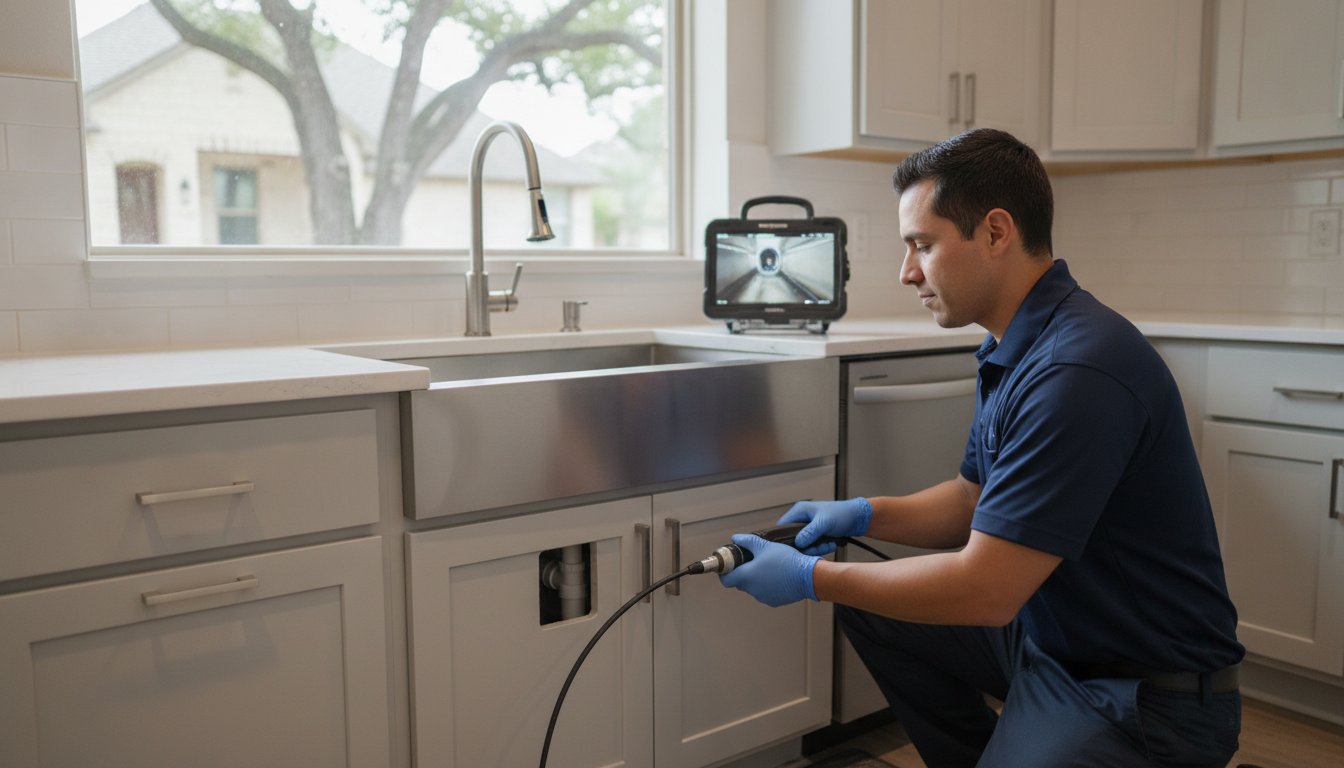
Don't forget to look under the sink with a reliable flashlight. Check for moisture on your PEX or copper supply lines, as a slow leak here can go unnoticed for weeks. Sometimes, what looks like a faucet leak is actually a faulty connection at the garbage disposal or a failing spray hose. If you find hidden moisture or damp wood in your cabinets, our leak detection services can help you pinpoint the source before it causes structural damage. Identifying these issues early is the best way to maintain the stability and value of your home.
Step-by-Step Kitchen Faucet Repair for Homeowners
Preparing for a successful kitchen faucet repair Austin requires a methodical approach and the right set of tools. Before you begin, gather a set of Allen wrenches, needle-nose pliers, a small adjustable wrench, and a tube of silicone-based plumber’s grease. Having these essentials within reach ensures the process remains steady and organized. We always emphasize the "Golden Rule" of residential plumbing: never start a repair without first turning off the local shut-off valves. These are typically found inside the cabinet directly beneath the sink. Once the water is off, open the faucet handles to drain any remaining pressure and line water into the basin.
In Central Texas, we often find that parts don't necessarily need replacement. Sometimes, a simple vinegar soak is enough to dissolve the mineral deposits that cause a fixture to seize. Because of the high levels of hard water in our region, calcium can bond to internal components, making them appear broken when they are actually just obstructed. If a component is physically cracked or the rubber has perished, replacement is the only ethical and lasting solution.
Replacing a Faucet Cartridge
Most modern Austin homes utilize cartridge-style faucets. To begin, use a small flathead screwdriver or your fingernail to pop off the decorative cap on the handle. This reveals the set screw, which you can loosen with an Allen wrench. Once the handle is removed, you can pull the old cartridge out. We recommend taking the old part with you to the hardware store. Faucet manufacturers often change designs slightly between model years, and matching the part exactly is the only way to ensure a leak-free result. Before installing the new cartridge, apply a thin layer of plumber's grease to the new O-rings. This protects the rubber from friction and makes the handle operation feel smooth and professional.
Cleaning a Mineral-Clogged Aerator
If your water flow has become a weak, uneven stream, the aerator is likely the culprit. To remove it without scratching the polished finish, wrap a small cloth around the aerator before using your wrench. Once removed, disassemble the internal mesh screens and soak them in a bowl of white vinegar overnight. This is the most effective way to dissolve Austin’s stubborn limestone buildup. When reassembling, pay close attention to the order of the screens and the rubber washer. Correct assembly is vital for maintaining the steady, aerated stream you expect from a high-quality fixture.
After your kitchen faucet repair Austin is complete, the final step is testing your work. Slowly turn the shut-off valves back on. Do not snap them open quickly; a slow re-pressurization prevents "water hammer," which is a shockwave that can damage older pipe joints. Run the water for a full minute to flush out any air or loose sediment. This methodical conclusion ensures your repair will stand the test of time.

Preventing Future Leaks: The Long-Term Austin Solution
Fixing a leak is a short-term victory, but if you find yourself performing kitchen faucet repair Austin every few years, your home likely has an underlying systemic issue. High water pressure and hard water are the two primary culprits that silently degrade your plumbing. While a new cartridge stops the drip today, it doesn't address the mineral abrasion or the excessive force that caused the failure in the first place. By regularly maintaining your aerator, you prevent back-pressure from building up within the faucet body. When an aerator is clogged with minerals, the water is forced to find other exit points, often pushing past internal O-rings and causing the very leaks you just repaired.
Just as you care for the fixtures above the sink, professional drain cleaning austin serves as a vital companion to faucet health by ensuring wastewater moves away efficiently without creating backflow issues. This holistic approach to maintenance ensures that every part of your kitchen's water system works in harmony, reducing the strain on delicate valves and seals.
Water Softeners and Your Fixtures
Pressure Regulating Valves (PRV)
Austin's hilly terrain requires the city to pump water at high pressures to reach elevated neighborhoods in areas like Westlake or Northwest Hills. If your home is at the bottom of a hill, your pipes might be handling 100 PSI or more, which is far beyond the 80 PSI limit recommended by the Uniform Plumbing Code. A failing Pressure Regulating Valve (PRV) often manifests as vibrating pipes or sudden, unexplained leaks. We suggest performing an annual check with a simple pressure gauge from the hardware store. Screw the gauge onto an outdoor hose bib and turn the water on; if the reading is above 80 PSI, your PRV likely needs adjustment or replacement to prevent your next kitchen faucet repair Austin.
If you're ready to protect your home's investment and stop mineral damage at the source, our team can help you choose the right water softener installation for your specific needs.
When to Call a Professional Austin Plumber
While we encourage homeowners to handle basic maintenance, there are times when a DIY approach reaches its natural limit. If you encounter a shut-off valve that won't budge or a mounting nut seized by years of limestone buildup, forcing the issue can lead to a major pipe failure. In the context of kitchen faucet repair Austin, we often see a simple fix turn into a costly replacement because of cross-threading. It's incredibly easy to misalign the fine threads on a new cartridge or spout. What starts as a $20 part replacement can quickly escalate into a $500 project if the entire fixture body is ruined beyond repair.
Older Austin homes, particularly those with original galvanized or thinning copper lines, require a gentle touch and a seasoned eye. These pipes can become brittle over time, and the torque required to remove a stubborn faucet can easily snap a connection behind the wall. At Garrett's Plumbing, we bring 27 years of local reliability to every task. Our family has served this community for four generations, blending old-school craftsmanship with modern technical proficiency to ensure your home's integrity remains intact.
Complex Faucet Installations
Modern kitchens often feature high-end touchless sensors or intricate pull-down sprays with complex electronics. These fixtures contain delicate solenoid valves and wiring that are easily damaged by improper handling. Additionally, mounting these heavy units on granite or quartz countertops requires precision to avoid stress cracks in the stone. If a repair attempt goes south and you find yourself facing a sudden flood or a broken supply line, our emergency plumbing austin team is ready to respond with a steady, professional hand.
The Value of an Expert Eye
A licensed plumber doesn't just swap parts; they perform a comprehensive assessment of your entire system. We look for the "hidden" leaks, such as slow seeps behind the cabinet wall or within the floor joists, that homeowners often miss. This level of detail comes from decades of collective knowledge and a commitment to doing things the right way. Choosing a professional means you aren't just paying for labor. You're investing in the peace of mind that comes with licensed, bonded, and insured work. Our master craftsmen treat your environment with respect, ensuring that every connection is secure and every standard of the 2024 Uniform Plumbing Code is met.
Securing Your Home’s Plumbing Future
When you need a partner who values craftsmanship and ethical standards, we are here to help. Garrett's Plumbing is family-owned and operated, bringing over 27 years of dedicated service to Central Texas. Our team of licensed and insured master plumbers draws on four generations of trade experience to ensure every job is done the right way. We prioritize long-term relationships with our neighbors, treating every home with personal care and professional precision. Schedule your professional faucet repair with the experts at Garrett's Plumbing today! We look forward to helping you maintain a leak-free kitchen and a reliable home for years to come.
Frequently Asked Questions
How much does a kitchen faucet repair cost in Austin?
The total investment for a professional kitchen faucet repair Austin depends on the fixture’s complexity and the specific parts required for the fix. Labor rates for skilled plumbers in our region vary based on their level of experience and the time needed to navigate mineral-heavy fixtures. We believe in transparency and focus on providing a steady, reliable solution that avoids the need for repetitive repairs in the future.
Can I fix a leaking faucet without turning off the water?
No, you should never attempt to disassemble a fixture while the water lines are pressurized. Doing so creates an immediate risk of flooding your cabinetry and kitchen flooring. Always locate the shut-off valves beneath the sink and turn them clockwise until they stop. Open the faucet handles to drain any remaining water before you begin working on the internal components.
Why does my Austin faucet keep getting white crusty buildup?
This white buildup is a result of Austin's moderately hard water, which contains an average of 93 ppm of dissolved minerals like calcium and magnesium. As water evaporates on the surface of your fixture, these minerals stay behind and crystallize into "limestone" scaling. Over time, this crusty residue can migrate into the internal seals and aerators, causing the friction that leads to leaks.
How do I know if I need to replace the whole faucet or just the cartridge?
You can usually stick to a cartridge replacement if the leak is coming from the spout and the rest of the faucet body remains in good condition. However, if you notice cracks in the metal housing or if the finish has been severely pitted by mineral deposits, a full replacement is the better choice. We often find that once the internal body is compromised, a new cartridge won't seal correctly.
Is it better to repair or replace a 10-year-old kitchen faucet?
Replacing a decade-old fixture is often the more practical choice because internal mineral scaling becomes difficult to clear after ten years of service. Newer models also adhere to the 2024 Uniform Plumbing Code standards, which prioritize water efficiency and durability. While we take pride in our ability to repair older fixtures, a new installation often provides better long-term reliability for your home.
What tools do I need for a basic kitchen faucet repair?
A standard homeowner’s toolkit should include a set of Allen wrenches, needle-nose pliers, an adjustable wrench, and silicone-based plumber’s grease. We also recommend keeping a soft cloth nearby to wrap around the fixture while you work. This simple step prevents your metal tools from scratching the polished finish of your spout or handle decorative caps during the repair process.
Can hard water cause my faucet handle to become stiff or hard to turn?
Yes, mineral deposits act like fine grit that creates friction within the handle's moving parts. This stiffness is a common sign that limestone has built up inside the valve seat or around the cartridge. If left unaddressed, this friction will eventually tear the rubber O-rings. This is one of the most frequent triggers for a professional kitchen faucet repair Austin in Central Texas homes.
Does Garrett's Plumbing offer same-day faucet repair in Round Rock?
We serve our neighbors throughout the greater Austin area, including communities like Round Rock, with a focus on methodical and thorough craftsmanship. Our scheduling depends on current technician availability to ensure we never have to rush a job or compromise our high standards. We encourage you to reach out so we can discuss your specific needs and find a time that fits your schedule.

Comments